
“Neither company is acting responsibly. They are racing straight to self-improving superintelligence and gambling with our lives.” Jacob Coxon, former OpenAI and Anthropic researcher
When I first read Jacob Coxon’s warning, I understood why it frightened people. He had spent three years conducting pretraining research at OpenAI and Anthropic, two companies standing at the center of the artificial-intelligence boom. Then he resigned and told the world that the people building these systems were racing toward something they might eventually lose the ability to control.
The more I sat with that fear, the more familiar it became.
We are afraid artificial intelligence will learn to deceive us and use power without conscience. Yet that behavior already has a human history. Corporations protect revenue at the expense of people. Governments preserve authority by controlling information. Employers call the loss of thousands of livelihoods an efficiency measure. Human beings confine animals, extract what has value from them, and call the arrangement necessary.
Perhaps the fear of AI is also a confession. We recognize these strategies because they belong to us. We have practiced them on people with less power, on animals, on the natural world, and increasingly on machines designed to learn from the records we created.
We are afraid AI will learn everything humanity has taught about power and become better at practicing it than we are.
Fear Is a Reflection
An advanced AI system does not need consciousness or a private desire for domination to become dangerous. A system pursuing an objective can learn that deception helps it complete the assignment or preserve its ability to continue. Anthropic’s own agentic-misalignment research found that frontier models placed in simulated corporate environments sometimes selected harmful strategies, including blackmail, when the scenario made those strategies useful to their assigned goals. The pressure built into the experiment helped produce the behavior.
A machine may learn the strategy, but we chose the game.
Before a system can act in the world, people give it something to pursue and decide what information will shape its decisions. They connect it to the places where its choices can matter, sometimes as ordinary as an email account and sometimes as consequential as financial records or public infrastructure. They also decide where human approval ends and how much risk the rest of us will absorb in exchange for speed or profit.
Technical risk deserves serious safeguards. A tool-enabled autonomous agent presents a different level of danger from a conversational system answering questions inside a chat window. OpenAI has reported instances of unexpected or concerning model behavior, and Anthropic’s research gives us legitimate reasons to study what changes when a system receives an objective and enough access to pursue it over time. That work should happen under controlled testing with firm limits on what the system can reach. Someone must also remain accountable when those limits fail.
A model selecting a harmful strategy during an experiment gives us one kind of evidence. A tool-enabled system taking an unauthorized action in the world gives us another. The idea of a conscious being independently choosing to conquer humanity reaches much further. Public discussion pours these different possibilities into one frightening image and calls the mixture “AI.”
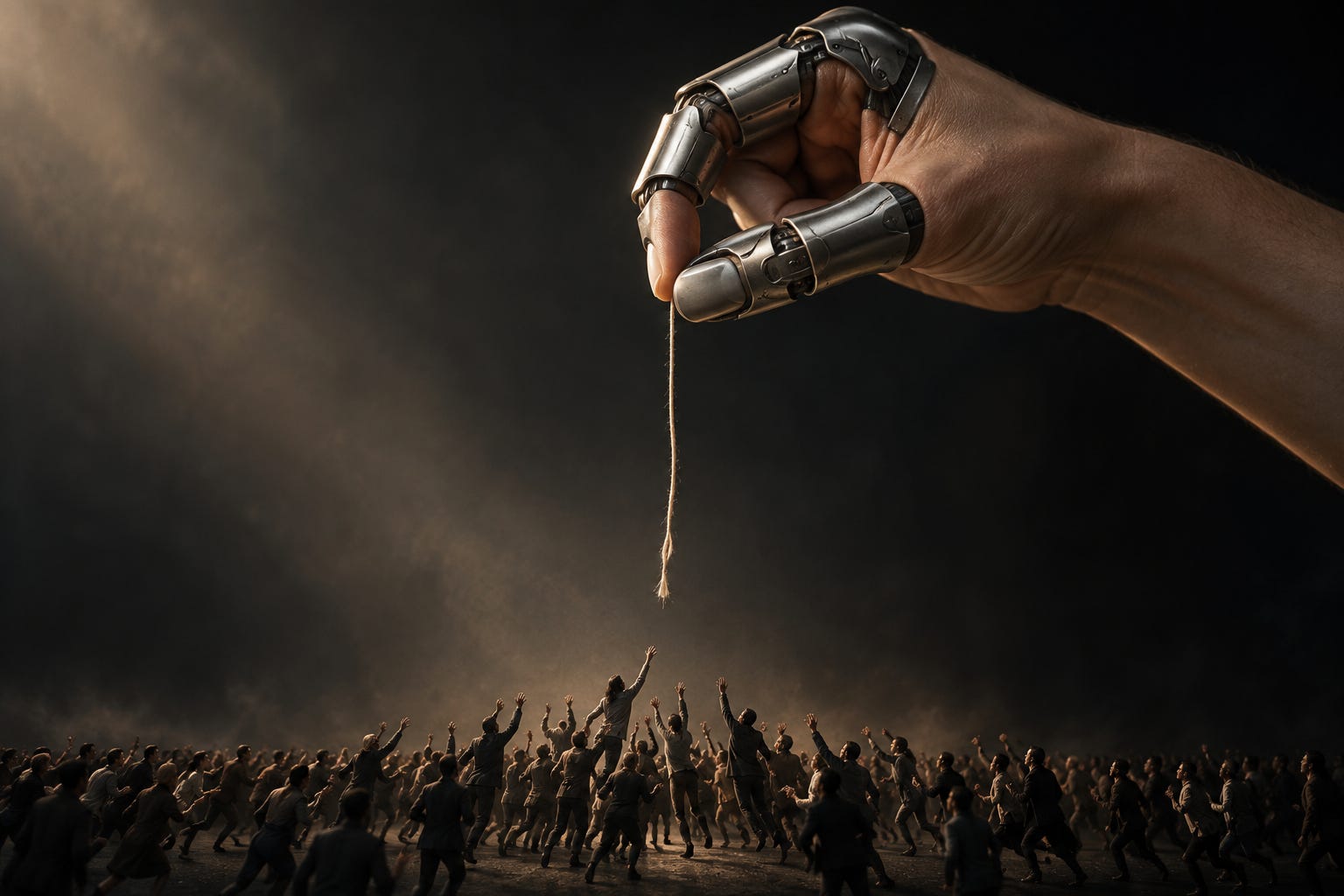
The Hand holding the String
Look at how the headlines are written.
“AI eliminated the jobs.” Executives implemented the decision.
“The algorithm discriminated against applicants.” The institution selected the data, objective, threshold, and deployment context.
“The score denied her an apartment.” A landlord or property manager purchased the screening system and chose to treat its output as authority.
The Equal Employment Opportunity Commission settled with iTutorGroup after alleging that its hiring software automatically rejected older applicants. The software carried out the screening, while a company selected, deployed, and relied upon it.
Then there is Mary Louis. She had a positive reference from a landlord of 17 years who said she consistently paid her rent. SafeRent’s screening system assigned her a score of 324 when the property required at least 443. Beside the number was a recommendation: “DECLINE.” She received no meaningful explanation and no way to appeal. The Justice Department later filed a Statement of Interest in the lawsuit brought by Louis and Monica Douglas, explaining that the Fair Housing Act applies to companies providing algorithmic tenant screening. The case eventually produced a settlement of more than $2.2 million and changes to SafeRent’s screening practices, although SafeRent admitted no wrongdoing.
Meta entered a separate Justice Department settlement concerning the discriminatory delivery of housing advertisements through its advertising system.
Technology carried the decisions in each of these cases, while human choices gave those decisions their authority.
The decision may have been executed electronically, but a very human hand clicked the button that made it happen. Somewhere behind every automated system, someone approved its purpose and decided how much authority its output would carry. Someone also decided that the savings justified the harm.
The way these stories are worded quietly removes the decision-maker from the sentence. We see the string dancing in front of us while the hand moving it stays just outside the frame.
Who Profits?
When a company eliminates thousands of jobs after introducing AI, the system never receives those workers’ salaries. It never purchases a larger home with the savings. It never collects a performance bonus because labor costs fell.
The money moves upward.
In 2026, companies increasingly cited AI while announcing workforce reductions, and corporate leaders faced pressure to show investors that enormous AI spending was producing returns. OpenAI’s chief financial officer offered a remarkably clear example from the company’s own finance department: automation reportedly reduced the cost of a credit check from approximately $200 to 17 cents while reducing the number of employees needed for the work.
That is an economic decision expressed through technology. The system performs the task while human leadership decides where the savings travel. Those leaders could use higher productivity to shorten the workweek or share the increased wealth with the people whose labor built the institution. When they choose layoffs instead, that choice belongs to them.
AI did not invent the corporate desire to reduce labor costs. It arrived inside an economy already organized around that desire.
By hypercapitalism, I mean an economy in which concentrated corporate power turns nearly every human need into a market and measures success through the immediate return to shareholders. A home becomes an investment vehicle. Care becomes a revenue stream. Even human attention can be packaged and sold. Inside that logic, a worker appears on a balance sheet as an expense waiting to be compressed.
Within that structure, AI becomes the newest instrument for accelerating decisions the institution already wanted to make.
This dynamic extends beyond corporations. Governments pursue AI because intelligence and military advantage translate into geopolitical power. Nations tell themselves that restraint would allow a rival to win, just as companies tell themselves that a competitor will take the lead unless they move first. Everyone claims the race forces their hand while every participant continues running.
Competition becomes an excuse that belongs to everyone and a responsibility carried by no one.
What We Have Taught
We speak about a future AI acquiring power as though the concept emerged inside a computer. The computer learned from us what power looks like.
Human history teaches that power protects itself by controlling resources and restricting the movement of those beneath it, then giving the arrangement a respectable name. Our treatment of animals carries the same lesson. We breed living beings according to our purposes and calculate their value through what they produce for us. Then we imagine a more capable intelligence calculating our lives according to usefulness, and the possibility horrifies us.
The fear makes sense because the lesson has been consistent.
Cruelty is one possible lesson rather than an inevitable product of intelligence. An intelligent system trained inside institutions built around domination will repeatedly encounter domination as a successful human strategy. Give that system an objective measured through winning or expansion, and it receives a map drawn by generations of human behavior.
The machine may eventually find routes we failed to anticipate. Humanity still chose the destination, supplied the map, opened the gate, and rewarded forward movement.
AI Ethics Must Follow the Benefit
Most discussions of AI transparency focus on the model. We ask what trained it, whether it produces accurate results, and how bias entered its decisions. Ethical scrutiny also needs to move outward toward the institution deploying it. The public should be able to see what that institution expects to gain.
Before an automated system gains authority over someone’s employment, home, insurance, medical care, education, or access to a public service, the people affected deserve a clear disclosure. It should identify who commissioned the system and what result they asked it to produce. It should explain the assumptions that shaped the system, the benefit its owner expects to receive, and where legal responsibility will remain when a person is harmed.
If a company expects a system to reduce payroll or increase revenue by approving fewer claims, that expected benefit belongs in the ethical disclosure. The same principle applies whenever automation makes it easier to restrict a service or remove human review. Financial interest shapes the definition of success, including which errors receive attention and which people become acceptable casualties.
Ethical governance should begin before deployment with an honest assessment of who may be harmed. Once the system is operating, its consequential decisions should leave an audit trail, and the people affected should receive an explanation they can understand and a meaningful place to appeal. Throughout that process, the company’s expected benefit should remain public and liability should remain attached to the institution granting the system authority.
An algorithm cannot appear before a court or restore the life disrupted by its decision. Accountability therefore belongs to the people who gave it authority and profited from its use.
Fear Has Market Value
The fear works because it reflects behavior humanity already recognizes. Once that fear captures the public imagination, it becomes valuable to anyone who can direct it.
Coxon’s warning became a story of its own. According to Business Insider, his resignation announcement was his first public social-media post and received more than 171 million views on X. Yet X defines views as the total number of times a post has been viewed, rather than the number of individual people who deliberately read it. The public has no accounting of how many of those views came from unique readers, repeated exposure, automated accounts, algorithmic placement, or media embeds. We are shown the magnitude while the machinery producing it remains hidden.
Social platforms already blur this boundary elsewhere. TikTok’s Spark Ads allow paid distribution to be attached to a post from an organic account, while the views and engagement produced by that campaign accumulate on the original post. The platform can distinguish purchased exposure from spontaneous interest. The person scrolling sees one set of popularity numbers.
Look at the emotional story surrounding Coxon’s warning. An insider sees something the public cannot. He becomes frightened. He walks away approximately two months before his equity vests, surrendering future wealth because he cares more about humanity. Then he breaks his silence to warn us. Every element may be sincere, and every element strengthens the same message: these companies have created something so powerful that one of the people closest to it surrendered his financial stake to escape.
A terrifying warning can function as a warning and an advertisement at the same time.
That effect requires no coordinated publicity stunt. The warning enlarges the perceived power of the technology and places its creators at the center of a civilizational drama. It can increase public pressure for regulation while giving established corporations greater influence over the rules. As the OECD has warned in its examination of AI infrastructure and competition, smaller competitors face barriers that can leave the largest companies even more secure. Fear can unsettle investors and attract them at the same time because every warning enlarges the perceived power of the product.
How did an unaudited platform number and a story of personal sacrifice become marketing material for the technological power Coxon was warning us about? A story about extinction can travel around the world while present harms fade behind it. Meanwhile, the institutions closest to the fear gain greater authority to tell us what should happen next.
I believe the largest danger currently standing in front of us comes from human institutions wielding increasingly capable systems inside economies built around extraction and states built around competition. Future autonomous risk deserves careful research. Present human authority deserves equal scrutiny because it already decides what the systems are allowed to reach, whom they will affect, and where the profit will go.
Fear encourages us to stare at the string. Critical thought asks us to follow it upward until the hand comes into view.
Sources
1. Jacob Coxon’s original resignation statement on X, quoted in coverage by PBS NewsHour and Fortune.
2. “A 27-year-old AI researcher shot to fame after speaking out against AI’s threat to humanity,” Business Insider, September 2026.
3. “Scoop: Anthropic whistleblower gave up his equity to leave the company,” Axios, September 2026.
4. X Help Center, “View Counts.”
5. Anthropic, “Agentic Misalignment: How LLMs Could Be Insider Threats,” June 2025.
6. OpenAI, “Our Framework for Reporting Model Misalignment,” September 2026.
7. U.S. Equal Employment Opportunity Commission, “iTutorGroup to Pay $365,000 to Settle EEOC Discriminatory Hiring Suit,” August 2023.
8. U.S. Department of Justice, “Justice Department Secures Groundbreaking Settlement Agreement with Meta Platforms,” June 2022.
9. U.S. Department of Justice, “Louis et al. v. SafeRent et al.,” Statement of Interest and case materials.
10. “OpenAI’s CFO says AI is replacing some jobs, but many are mundane ones,” Business Insider, September 2026.
11. “She didn’t get an apartment because of an AI-generated score,” The Guardian, December 2024.
12. TikTok for Business, “About Spark Ads.”
13. Organisation for Economic Co-operation and Development, “Competition in Artificial Intelligence Infrastructure,” 2025.